Maasai Culture in Tanzania
Maasai Culture in Tanzania
The Maasai people of Tanzania are among the most recognized cultural communities in Africa, yet their identity extends far beyond visual symbolism. To understand Maasai culture is to understand a way of life shaped by land, livestock, community, and continuity.
For travelers seeking meaningful cultural experiences in Tanzania, learning about the Maasai offers insight into values rooted in responsibility, respect, and coexistence with nature.
This is not a culture preserved behind glass. It is living, adaptive, and deeply grounded in tradition. Approached respectfully, Maasai cultural experiences enrich travel by adding human context to landscapes often known only for wildlife.
Who the Maasai are and where they live
The Maasai are a semi-nomadic pastoralist community traditionally inhabiting northern Tanzania, particularly in areas surrounding the Serengeti plains, Ngorongoro Conservation Area, and the Great Rift Valley. Their settlements are shaped by seasonal movement, driven by grazing patterns and access to water for livestock.
Rather than permanent urban centers, Maasai life is organized around villages known as bomas. These communities reflect a collective lifestyle where cooperation, shared responsibility, and mutual support are essential. The landscape is not simply a backdrop to Maasai life it is an active partner in daily decision-making.
History and Origins of the Maasai People
Maasai history is preserved primarily through oral tradition rather than written records. According to these traditions, the Maasai migrated southward centuries ago from the Nile Valley region, eventually settling across present-day Tanzania and Kenya.
Over generations, they developed a pastoral culture uniquely adapted to East Africa’s semi-arid environments. Despite colonial disruption, land loss, and modern pressures, the Maasai have retained a strong sense of identity rooted in language, customs, and social structure. Their history is one of resilience adapting to change while preserving cultural continuity.
The Importance of Cattle in Maasai Culture
Cattle lie at the heart of Maasai culture. They are central not only to livelihood, but to spirituality, social status, and community relationships. Traditionally, cattle provide milk, meat, and materials, but their value extends far beyond economics.
Livestock represent wealth, responsibility, and the bond between people and land. Ceremonies, marriages, and social obligations often involve cattle, reinforcing their role as a unifying force within the community. Understanding this relationship helps travelers appreciate why land access and grazing rights remain deeply important to Maasai identity.
Social Structure, Age Sets, and Community Roles
Maasai society is organized through an age-set system that defines roles, responsibilities, and progression through life. From childhood to elderhood, each stage carries specific duties that support community stability.
Elders hold authority and guide decision-making, drawing on wisdom and experience. Traditionally, warriors were responsible for protection and livestock security, while women managed households, built homes, and maintained family life. Although roles are evolving, the underlying emphasis on collective well-being remains strong.
This structure fosters unity and accountability, ensuring that every individual contributes to the strength of the community.
Traditional Dress, Beadwork, and Cultural Symbolism
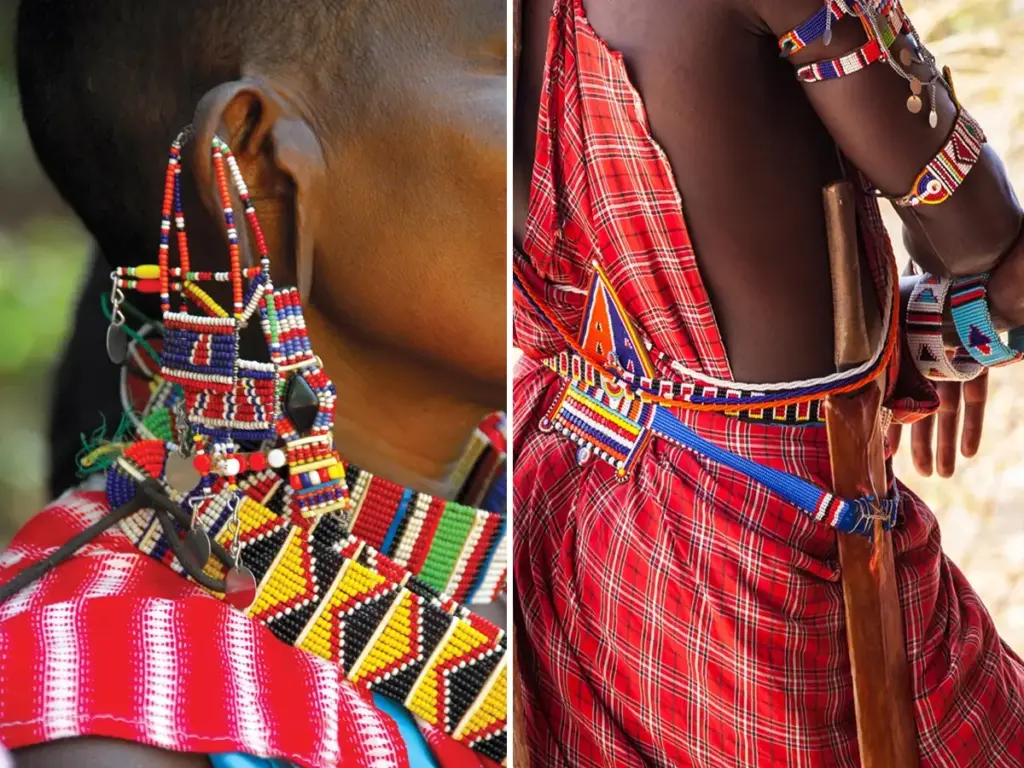
Maasai dress is both functional and symbolic. The well-known red shúkà cloth is worn for protection and visibility, symbolizing strength and courage. Beadwork crafted primarily by women is rich with meaning, using color, pattern, and design to communicate age, status, and life stage.
Each piece of jewelry tells a story. Colors such as red, blue, white, and green reflect concepts tied to land, sky, purity, and life. Far from decorative alone, Maasai adornment is a visual language passed down through generations.
Daily Life in a Maasai Village (Boma)
Life in a Maasai boma follows natural rhythms rather than fixed schedules. Homes are traditionally built from locally sourced materials, designed to provide shelter while remaining adaptable to environmental conditions.
Daily routines are shaped by livestock care, household responsibilities, and community interaction. Mornings may begin with tending cattle, while evenings bring shared meals and conversation. For visitors, time spent in a Maasai village offers perspective on a lifestyle where cooperation and simplicity guide daily living.
Ceremonies, Rituals, and Rites of Passage
Ceremonies play a vital role in marking life transitions within Maasai culture. Birth, initiation, marriage, and elderhood are recognized through rituals that reinforce identity and continuity.
Music, chanting, and movement are integral to these ceremonies, serving as expressions of unity rather than performance.
While some rituals are private, others may be shared respectfully through guided cultural visits. Understanding that not all traditions are open to outsiders is essential to ethical engagement.
The Maasai Relationship with Land, Wildlife, and Nature
The Maasai worldview emphasizes coexistence with nature rather than domination over it. Land is held communally, and traditional grazing practices are designed to sustain ecosystems over time. Seasonal movement prevents overuse of resources and supports biodiversity.
This perspective has long aligned with conservation principles now widely promoted in modern environmental management. In many protected areas, Maasai knowledge contributes to sustainable land-use discussions, highlighting the value of indigenous wisdom in conservation efforts.
How Maasai Culture Adapts to the Modern World
Maasai culture is not static. Today, many Maasai engage with education, healthcare, entrepreneurship, and political advocacy while maintaining cultural roots. Some families combine traditional livelihoods with modern opportunities, balancing heritage with changing realities.
Adaptation does not mean loss of identity. Instead, it reflects a dynamic culture capable of navigating the modern world without abandoning core values. Travelers who recognize this evolution gain a more accurate and respectful understanding of Maasai life today.
Responsible and Ethical Ways to Visit Maasai Communities
Cultural tourism carries responsibility. Ethical visits are community-led, transparent, and mutually beneficial. Travelers should approach Maasai cultural tours with respect, curiosity, and humility listening more than speaking, asking permission before photography, and avoiding assumptions.
When conducted responsibly, cultural tours support education, healthcare, and economic opportunities while preserving dignity and autonomy. Choosing operators who prioritize ethical engagement ensures that cultural exchange remains meaningful rather than extractive.
Why Maasai Cultural Experiences Matter When Traveling in Tanzania
Learning about Maasai culture adds depth to any journey through Tanzania. It connects landscapes to human stories and wildlife to centuries-old knowledge systems. These experiences remind travelers that Tanzania is not only defined by its national parks, but also by the people who have shaped and protected these lands for generations.
A respectful Maasai cultural experience encourages reflection on community, sustainability, and the values that define meaningful travel. For many visitors, this understanding becomes one of the most lasting memories of their time in Tanzania.
Other Cultural Tours
Mikumi National Park

Nyerere National Park